The Hungarian-based low-cost carrier Wizz Air has started a huge recruitment drive for new airline pilots. Over the next five years, they’re looking to almost double their fleet size, to a total of 500 Airbus aircraft. With this significant fleet expansion comes the need for more pilots, and lots of them!
Wizz cites they’ll require 1,200 new pilots by 2028, including 240 based in the UK. Some of these places will be taken by direct entry pilots from other airlines, but Wizz are looking to fill many of them with new cadets who’ll come through their own pilot training scheme, the Wizz Air Pilot Academy.
The scheme’s a popular topic amongst the aspiring pilot community, and one I get asked lots of questions about. After doing my own digging, there are definitely things any applicant needs to be aware of and seriously consider before applying. Frustratingly, the company’s own website isn’t very clear on the finer details of various parts of the scheme, and you’ll see many articles online wrongly claiming that Wizz are offering fully-funded pilot training through their scheme, along with various other bits of confusing and inaccurate information.
In this article, instead of just regurgitating the marketing information on Wizz’s own website as other aviation websites have done, I’m going to cut through the marketing and dissect what this programme really means for aspiring pilots, and what life would look like after training. We’ll look at the pros, the cons, and everything in between of the Wizz Air Pilot Academy. As a current short-haul airline captain based in the UK, and having come through a sponsored scheme myself, I’ll also be giving my personal opinion on it.
To ensure this article is as accurate and valuable as possible, I’ve combed through the T&Cs and FAQs of the programme, along with speaking to current Wizz pilots and trawling many, many forums. I’ve condensed all of that, along with my findings, into this relatively comprehensive article.
For those who are looking to apply, I’ll include specific tips to help you through the Wizz Air Pilot Academy application and selection process. I’m also working on another post that’ll go into far more depth about what airline recruitment teams are looking for in general during a selection process. To be notified when this comes out, sign up for notifications using the box at the bottom of the page.
Also, for those looking for guidance on becoming an airline pilot as a whole, take a watch of my honest guide below!
Overview: Wizz Air Pilot Academy at a glance
Started in 2017, Wizz Air Pilot Academy (WAPA) is the airline’s in-house, fully integrated pilot training programme. The scheme takes you from little to no flight experience to the front seat of their A320 jets.
It’s an ATPL (Airline Transport PIilots Licence) course, and the training is broken down into three main stages, all of which take place in Hungary. By the end of the course, the aim is to have you employed with Wizz Air as a first officer.

We’ll dive into the financials in depth later on, but something I want to make very clear from the outset is that this is NOT a fully-funded scheme. Yes, Wizz Air helps you by deferring some of your flight training costs, but you’ll still have to cover them eventually.
A handy resource is their WAPA guidebook, but to save you time scouring it for the most relevant information, I’ve broken down an overview of the scheme below. Let’s start with requirements:
Requirements To Apply
- Age 18 or above
- Minimum high school degree
- Good command of English knowledge
- Good understanding of Maths and Physics
- Ability to swim 50 meters without any help
- To be based and have unrestricted right to live and work in one of the following countries where Wizz Air has an operational base: Albania, Armenia, Bulgaria, Georgia, Hungary, Moldova, North Macedonia, Poland, Romania and Serbia
The last point is very important. Unfortunately, for many UK nationals, this rules you out of the running (you can thank Brexit for that). However, Wizz Air does have bases in the UK, operated by its subsidiary airline ‘Wizz Air UK’, which has recently partnered with a UK-based flight school, Leading Edge, to tag student pilots who are already on training courses with that school. More info on that partnership can be found here.
This means that if you’re based in the UK and desire to fly for Wizz Air, you may not be eligible to join the WAPA in Hungary, but you can self-enrol in Leading Edge, and you’ll have a chance of being tagged by Wizz Air UK.
Whilst being tagged doesn’t bring you any financial support during training, it will bring you peace of mind to know you have a job lined up as soon as your training is completed.
Selection Process
Application
The first part of the selection process is the application itself. You can apply to the WAPA here. As part of this application, you’ll be asked for a CV and cover letter, amongst other bits of administrative paperwork. You’ll also be asked to answer two questions:
What is your motivation to apply for this program?
How would you describe an ideal Wizz Air pilot?
For information on precisely what the Wizz Air recruiters will be looking for in your CV, cover letter, and answers to the above questions, grab a copy of my book ‘How To Become An Airline Pilot’, where I break it down and use detailed examples to help you craft the perfect application.
Once you’re through the application, there are four stages of the selection process:
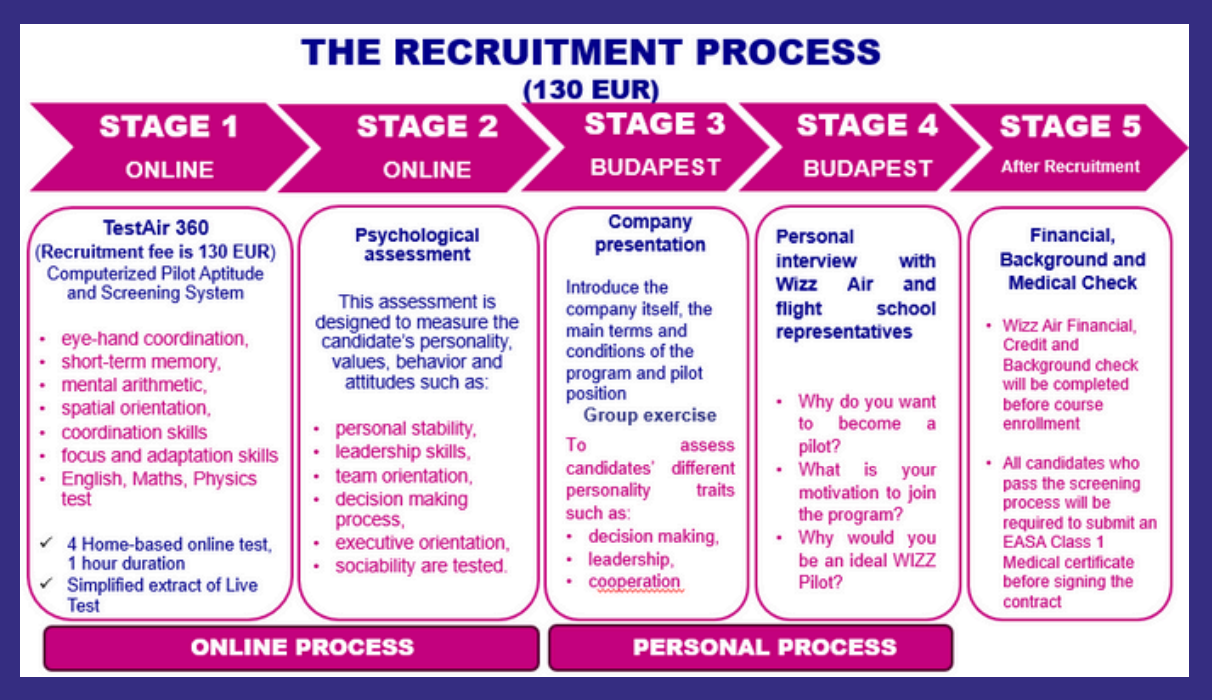
The above illustration from their website makes it look super complex, but let’s break it down:
Stage 1
Before commencement of stage 1, you’ll be asked to pay a non-refundable €130 recruitment fee. This feels a little cheeky in my opinion, but it’s a way for them to filter out applicants who aren’t serious.
This stage is aptitude testing, and the best way to prepare is to practice. Wizz Air use the Test Air 360 software, and you can prepare using the same software directly from their website here. It comes at a price, but it’ll be worth the small fee to give you the best chance of passing.
Another great resource for selection preparation is PilotAptitudeTest.com. They have bespoke tests, tailored to each airline’s selection process, and have one specifically for Wizz Air. If you follow this link and use code PILOTBIBLE, you’ll get 10% off your order.
Stage 2
The psychological assessment now makes up part of the pilot selection process for most airlines. This will likely be a series of multiple-choice questions designed to help the company determine whether this is the right role for you.
My best advice here is just to be yourself. There’s no point answering untruthfully or just choosing the answer that you think the company want to hear, as you may just end up further along in a selection process for a role that you’re genuinely not suited to. Although the job of an airline pilot certainly has its perks, it’s absolutely not a job for everyone, and the reality of it could be very different to your perception, so it’s definitely in your best interest to answer these questions honestly.
Stage 3
This is the first in-person stage of the process, and it will be held at their training centre in Hungary. You’ll have to organise and pay for your own travel and accommodation, which is commonplace now with airline selection days.
The aim of stage three is to test your competencies across a series of group exercises with other candidates. Although the recruitment page states they’re focusing on your decision-making, leadership, and cooperation skills, there are actually nine pilot competencies they’ll be looking out for. All of these are broken down and explained in my book, along with how best to navigate the group exercises.
Stage 4
The dreaded interview. The key here is thorough preparation and research, followed by lots of practice. You’ll be expected to have a good level of knowledge about the company, be able to explain your motivation to work for them, and be asked competency-based questions. Again, the selection process section of the book will tell you everything you need to know about the interview stage.
Stage 5
If you pass all the previous stages, you’ll have to show proof of a class 1 medical certificate before you go any further. You gain one of these by going to an Aviation Medical Examiner (AME) and undergoing a thorough medical examination. You don’t have to get one of these until you’ve reached this stage, but I’d suggest it’s a good idea to get one beforehand.
The reason for this is that it may bring a medical issue to light that needs addressing before a class 1 can be given. There will be nothing more soul-destroying than passing the first four stages of selection, only to find that you can’t accept a place on a course due to a medical problem that needs treating.
Initial class 1s can be expensive (around £800), but you’ll need one to fly for an airline anyway. You can find your local AME by going to your relevant aviation authority’s website and searching for qualified examiners near you.
Training Course Overview
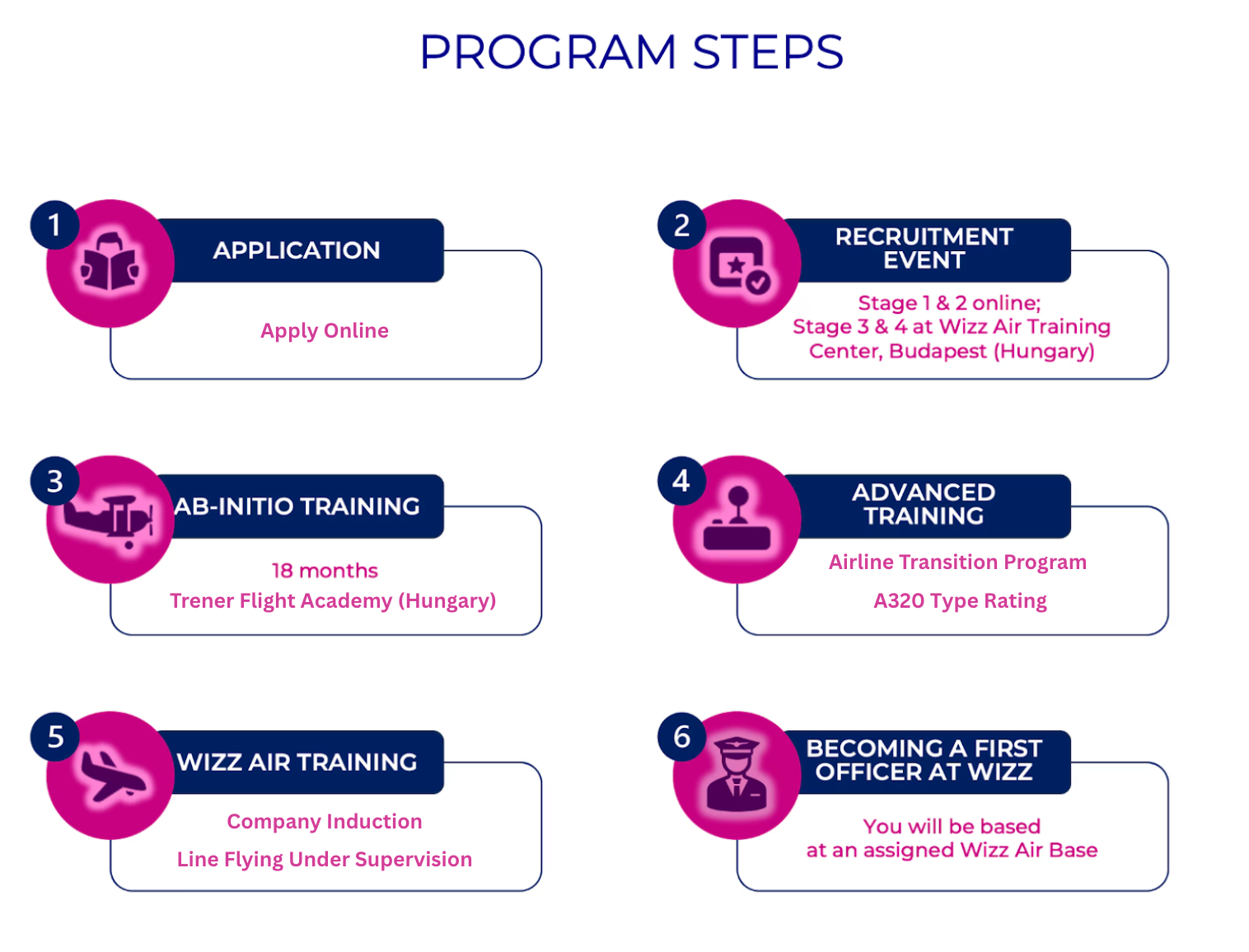
The planned course footprint is around 2 years long and will culminate in you attaining a Frozen ATPL along with an A320 type rating. The course is broken down into 3 phases:
Ab Initio Training
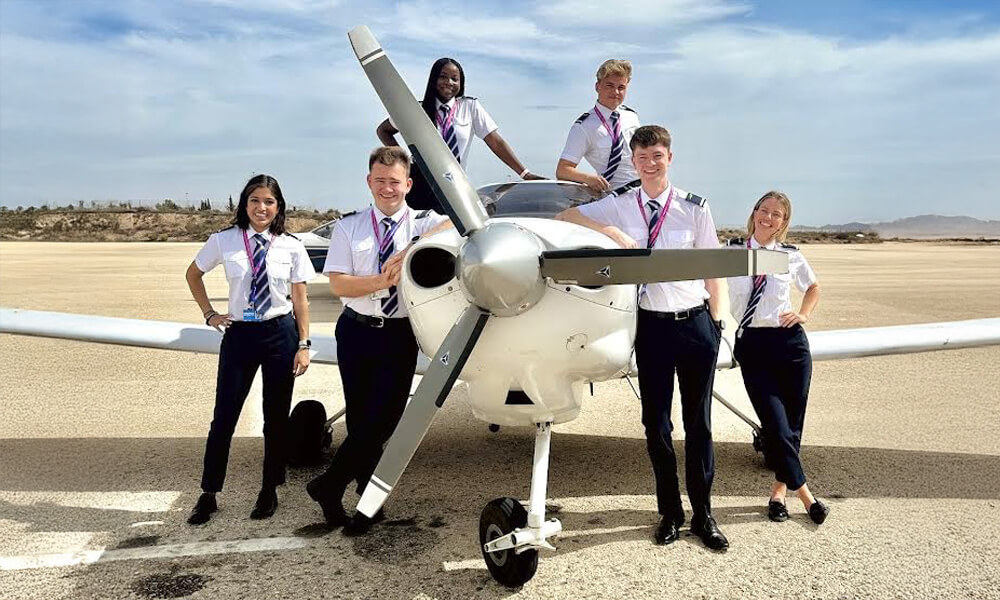
The ab initio training takes place at Tréner Flight Academy, based in Nyíregyháza, Hungary. This phase is fully integrated, meaning it’s full-time and you’ll live either on or very near the training campus. It takes around 18 months, during which you’ll complete the following:
- Ground School ATPL Theory Exams
- Commercial Pilot Licence (CPL)
- Multi-Engine (ME) & Instrument Rating (IR)
- Upset & Recovery Prevention Training (UPRT)
- Airline Pilot Standard Multi-Crew Cooperation Course (MPS ACC)
You’ll leave this stage with a frozen ATPL (more on what a frozen ATPL actually means in a post I’m just working on – sign up to be notified when it’s out), but you won’t yet be able to fly an airline, as you don’t have a type rating.
Advanced Training
This phase is the transition between what you’ve done so far and operating large jets. It’s broken into two separate phases:
- Airline Transition Program – ATP
This is a 5-day course focusing on multi-crew airline operations, and preparing you for your A320 type rating with three simulator sessions. - A320 Type Rating
This is a 5-week course consisting of ground school, simulator sessions, and, finally, base training to complete your A320 type rating.
Wizz Air Training
This final phase of training starts with a company induction, where you’ll learn Wizz Air’s specific procedures and SOPs across 6-7 weeks in a classroom setting. Once complete, you’ll start flying passenger flights in what’s known as line flying under supervision. You’ll be operating with qualified training captains for a set number of sectors (usually around 50) before being put forward for your final line check. Once complete, you’ll be fully qualified as a Wizz Air First Officer.
Finances
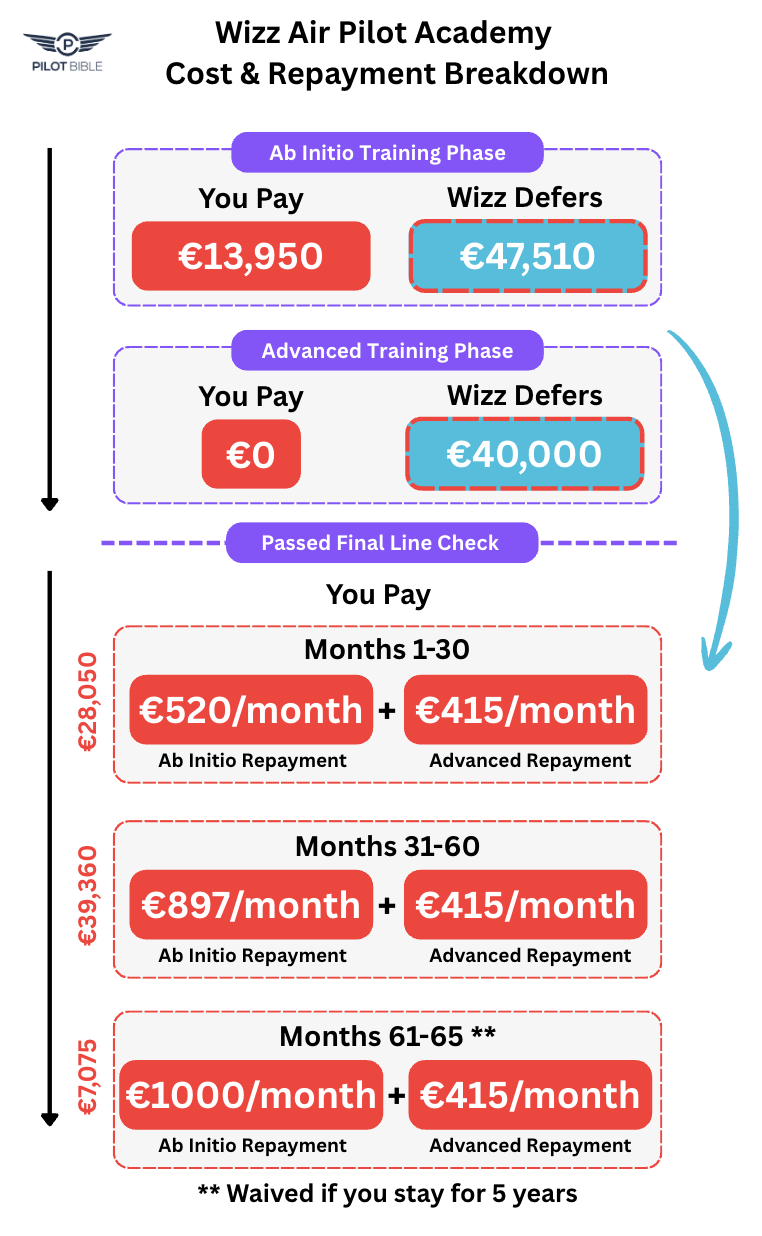
All sounds pretty great so far, huh? Well, now let’s get into the interesting part. This scheme’s been labelled as ‘fully-funded’, but I’m afraid to break it to you, that’s really not the case. The finance side of things is hard to clearly decipher on their website, so I’ve explained everything below and included diagrams to make it as digestible as Wizz Air really should be doing!
Wizz Air do, very kindly, defer the costs of the majority of your flight training, allowing you to complete the entirety of your training without having to put much money down. They will, however, ensure that they get this money paid back to them by you, by taking it from your salary once you’re employed. Let’s break down how this financing works across the different stages.
Costs
Headline costs: Your training will cost you €101,460 in total. This figure is reduced to €81,460 if you stay with Wizz Air for 5 years. This is because they waive a total of €20,000 from your training bill as a loyalty bonus if you do so (€5,000 from your ad initio training, and €15,000 from your type rating).
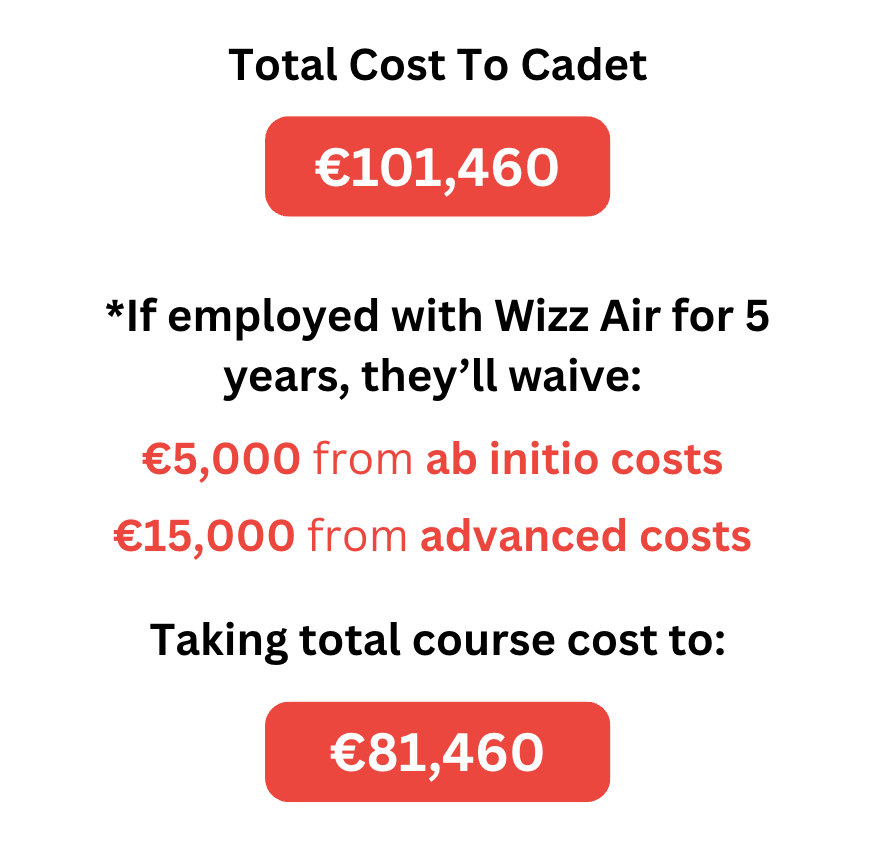
As I mentioned earlier, Wizz kindly defers part of this overall cost to minimise what you have to pay upfront. They’ll then take instalments from your paychecks for the first 5 years of your employment. Let’s break down each stage:
Ab Initio – Total Cost €61,460.
You pay €13,950 upfront. Wizz defers €47,510
Advanced Training – Total Cost €40,000 (waived to €25,000 after 5 years employed with Wizz)
You pay €0. Wizz defers all of it.
There are other expenses to take into account, too. During the initial part of your training, you won’t be paid a salary, and your accommodation, food, and other basics aren’t included in the cost of your course. You’ll therefore have to cover these costs yourself. Wizz notes in their brochure that they’ve partnered with ‘Hotel Sandra’ near the training airport to offer cadets stays at reduced rates, but it’s likely that it’ll be cheaper to find some shared accommodation with other cadets.
Cost Repayment
As soon as you’ve passed your final line check, Wizz will expect you to start paying back the following amounts;
Months 1-30: €520/month for ab initio training, PLUS €415/month for advanced training
Months 31-60: €897/month for ab initio training, PLUS €415/month for advanced training
Months 61-65: €1000/month for ab initio training*, PLUS €415/month for advanced training
** As mentioned previously, the final five instalments of €1000 are waived if you remain at Wizz for five years. The €415/month for advanced training is based on the total cost of that phase already being reduced by Wizz to €25,000.
Their website doesn’t make it abundantly clear that you’ll be required to pay back two loans at the same time (for the ab-initio and for the advanced training). Having that financial commitment each month can put a lot of pressure on a newly qualified first officer, so let’s take a look at how much you’ll be getting paid as a salary.
Salary
You’ll start getting paid a salary from day 1 of your Advanced Training. This is actually pretty good to see. Many schemes don’t pay you a salary until you’ve passed your final line check.
Initially, you’ll be on a training salary. Exact figures are hard to find, but this sits around €40,000/year. You shouldn’t be on this for too long, because as soon as you pass your final line check at the end of the Wizz Air training phase, you’ll be on a first officer’s salary, which is around €60,000/year.
Wizz Air Pilot Academy Benefits
There’s a lot about this scheme that’s really positive:
Deferred Payment & Waived Fees
You’re only required to put a relatively small amount of money down to enable you to proceed through flight training. Although the total cost of training that you’ll have to repay is substantial (€100,000), many flight schools would require you to pay a similar amount upfront. Wizz Air, on the other hand, fronts most of this cost initially, and then defers your repayments until you’re flying as a first officer, and on a salary with them.
The opportunity to have €20,000 waived from your training debt if you stay with Wizz Air for 5 years is also very attractive. For some, it may still make more financial sense to move to a different airline with a higher salary before the five years are up, but for those who plan to stay at Wizz Air, it’s a nice added bonus.
For those staying for the full five years and beyond, the amount waived by Wizz brings your total training cost down to around €80,000, which, for a full ATPL course and A320 type rating, is a highly competitive price.
Training Salary
Not all schemes offer a training salary, and whilst Wizz doesn’t pay you during the ab initio part of your training, they will start paying you a training salary from when you commence the advanced phase. During this time, you won’t be required to pay any monthly instalments back for your training loans, so this gives you a nice period to build a bit of a financial buffer and peace of mind that even if your advanced phase takes longer than expected to complete, you’ll still be earning a salary during this time.
ATPL
This course with Wizz Air is an ATPL course. One huge benefit of this is that you’re not necessarily tied to Wizz Air during or after your training (aside from the 5-year financial bond). What I mean here is that all the training you do (CPL, ME, IR), and the licence you work towards (ATPL) is applicable across the industry. This gives you flexibility during training and, as a new first officer, should you no longer wish to be part of Wizz Air’s academy or airline (or if the airline goes bust). Of course, if you decide to leave, you’ll have to repay training costs, but they’re similar to what you would’ve paid elsewhere.
For other airline schemes that sometimes follow the MPL licence training structure and are very specific to the airline they’re run by, this might not be so easy, and you’re far more ‘tied in’.
Job Security
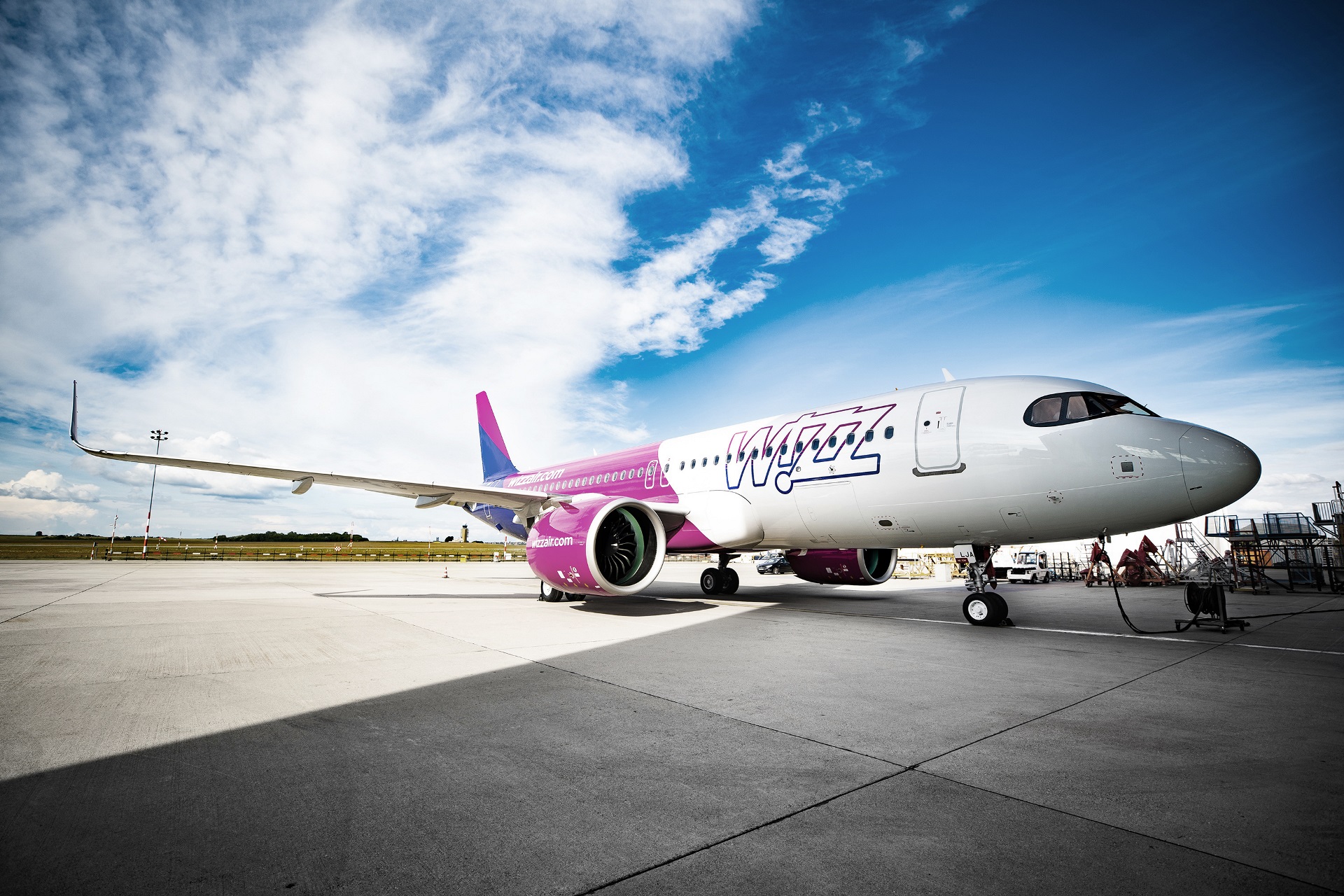
From day one of your training, you know that you have an airline job waiting for you when you finish. This is a great situation to be in, and a luxury that ‘whitetail’ cadets, who self-fund their way through flight school, don’t have.
As well as this, once Wizz Air employs you, you’ll find yourself in a relatively stable company. Although they’ve faced some obstacles recently with engine issues, their commitment to this significant fleet expansion suggests that joining Wizz Air is likely to be a secure place to be for the foreseeable future (well, as secure as an aviation job can get).
Things You Must Consider
Right, let’s talk about things that you seriously need to consider before looking to apply, some of which may not be so rosy.
5–Year Bond
Having a bond to deal with is now commonplace with any airline training scheme, even the most popular ones, such as BA’s Speedbird Academy. It’s not necessarily a bad thing, as having this bond is the only way that Wizz enable you to complete two years’ worth of very expensive training, having only put a tiny fraction of it up yourself. It is, however, something to be very aware of, and ensure you understand the intricacies of exactly how it works.
As an overview, you are bonded to Wizz Air for five years after you pass your final line check. During this time, you’ll be repaying your flight training fees in structured instalments as outlined earlier in the article. During these five years, if you leave Wizz Air, by your own accord, you’ll have to pay back the outstanding amount of your training fees.
This means that for those who leave in their first year, they’ll likely have around €100,000 to repay. As you progress through the first five years of employment with Wizz, the outstanding amount reduces as you pay it off. At the five-year mark, they waive the final €20,000 of your debt, and should you wish to leave after that, you’ll owe the company nothing.
In a nutshell, the bond is just a financial one. You can leave the company whenever you want, but if it’s during this bond period, you’ll have to cough up some money to cover your training costs. I think that’s fair enough!
Starting Pay
The starting salary at Wizz Air isn’t awful, but it’s also not amazing. Your initial salary as a first officer will be around €60,000, including all flight pay, etc. As soon as first officers reach 500 flying hours, they’ll be able to apply to legacy carriers such as British Airways, which offer a starting salary of around €80,000.
€20,000+ extra per year goes a long way, and it’s a move that many Wizz Air cadets make, quite understandably.
Operational Requirements
You’ll see many caveats in the Wizz Air small print citing the words ‘subject to operational requirement’ or similar. It ensures the company has maximum flexibility, but it can have huge implications for you.
One of the ways it could impact you is your base location. Once you’ve finished your training, you’ll be placed at one of Wizz Air’s EU bases. Although you can select a preference, your base allocation will ultimately be determined by ‘operational requirements’. I like to think airlines genuinely do consider these preferences, but it’s very common for new pilots to end up displaced from home for the first few years, at a base they don’t wish to be at, until they can get a transfer back to the base closest to their home.
Throughout your time with Wizz, your base will also be subject to operational requirements. Admittedly, this is the same in any major airline, but low-cost carriers have a history of closing and opening various bases more than legacy carriers, forcing their staff to relocate. A recent example of this from Wizz Air UK in 2025 was the decision to permanently relocate an aircraft from their Gatwick base to their Luton base. This meant a number of pilots were selected to relocate with it, at least one of whom I know decided to leave the company when it became clear that they had no other option.
Another place you may see the phrase ‘subject to operational requirements’ is in the employment section of the contract. If you complete the ab initio part of your training, but due to unforeseen circumstances, the industry takes a downturn, and Wizz suddenly doesn’t need more pilots at that time, there may no longer be an offer of employment waiting for you at Wizz Air, and your training will likely be on hold.
EU Restrictions
An applicant must have the right to live and work in the EU. Thanks to Brexit, many British nationals don’t. This is hugely frustrating as the scheme has many great things about it, but unless you meet those requirements, you cannot apply to WAPA.
High Failure Rate During Selection
After trawling the relevant forums to hear from people who’ve already applied, it sounds like there’s a very high rejection rate at the application stage. It’s unclear whether this is due to many people applying who don’t meet the basic requirements, or whether Wizz has set an extremely high bar for moving anyone through to the selection process. There are also many people on the forums stating that they felt they excelled during the selection process, only to be rejected.
The lesson here is to go into the process with your eyes open. Ensure you do all the required work to give yourself the best possible chance of success, but don’t be disheartened if you don’t succeed. You can always try again, or try one of the other airline schemes out there.
Training Location
Successful applicants of this program will spend at least 18 months of their life in Nyíregyháza, Hungary. Whilst many large flight schools host their ground school and flying phases in different parts of the world, Wizz complete all of it in Hungary.
You should initially consider whether spending this amount of time in Hungary is viable for you. I’d also suggest that you consider whether this is where you want to spend all this time. Other flight schools offer training in USA, UK and a variety of other countries. It sounds cliché, but you need to make sure you enjoy the journey, not just the destination, so make sure you’re going to be training at a place where you want to fly.
Life at Wizz Air
Like many low-cost carriers, Wizz Air are known to fly their pilots hard. Summer can bring with it relentless rosters, and with that comes high levels of fatigue. They also have a CEO who, to put it lightly, doesn’t appear to be very empathetic with the pilot workforce and the levels of fatigue they contend with, as explained in the fatigue section of my article onpilot mental health here.
On Glassdoor, Wizz has a rating of 3.5 / 5, which is substantially lower than similar European-based low-cost airlines such as easyJet (4.2 / 5), and many in the industry view Wizz as a ‘starter airline’, where pilots gain hours and experience before moving to legacy airlines, which can generally offer a better lifestyle.
That said, Wizz Air is not a bad airline. They run a safe, efficient airline flying new, state-of-the-art A320/21 aircraft. Their crews are well trained, and the salary once you’ve been in the airline for a few years can be pretty lucrative. You’ll work hard for that salary, though, with multiple sectors per day, usually involving very early starts or very late finishes. This lifestyle isn’t necessarily Wizz Air specific though, it’s how most low-cost short-haul carriers now operate. For some, it works. For others, it can be a struggle, especially if you have a family at home. Wizz Air do offer part-time options for pilots, which can help make the working life more sustainable.
I’m working on putting together an article from a current Wizz Air pilot to give you a real insight into life behind the scenes there. Sign up at the bottom of the page to be notified when this article is released.
Comparative Analysis
Wizz Air aren’t the only one offering their own airline pilot training scheme, so how does it stack up compared to the others? Please note that the following are available in the UK:
BA Speedbird Pilot Academy
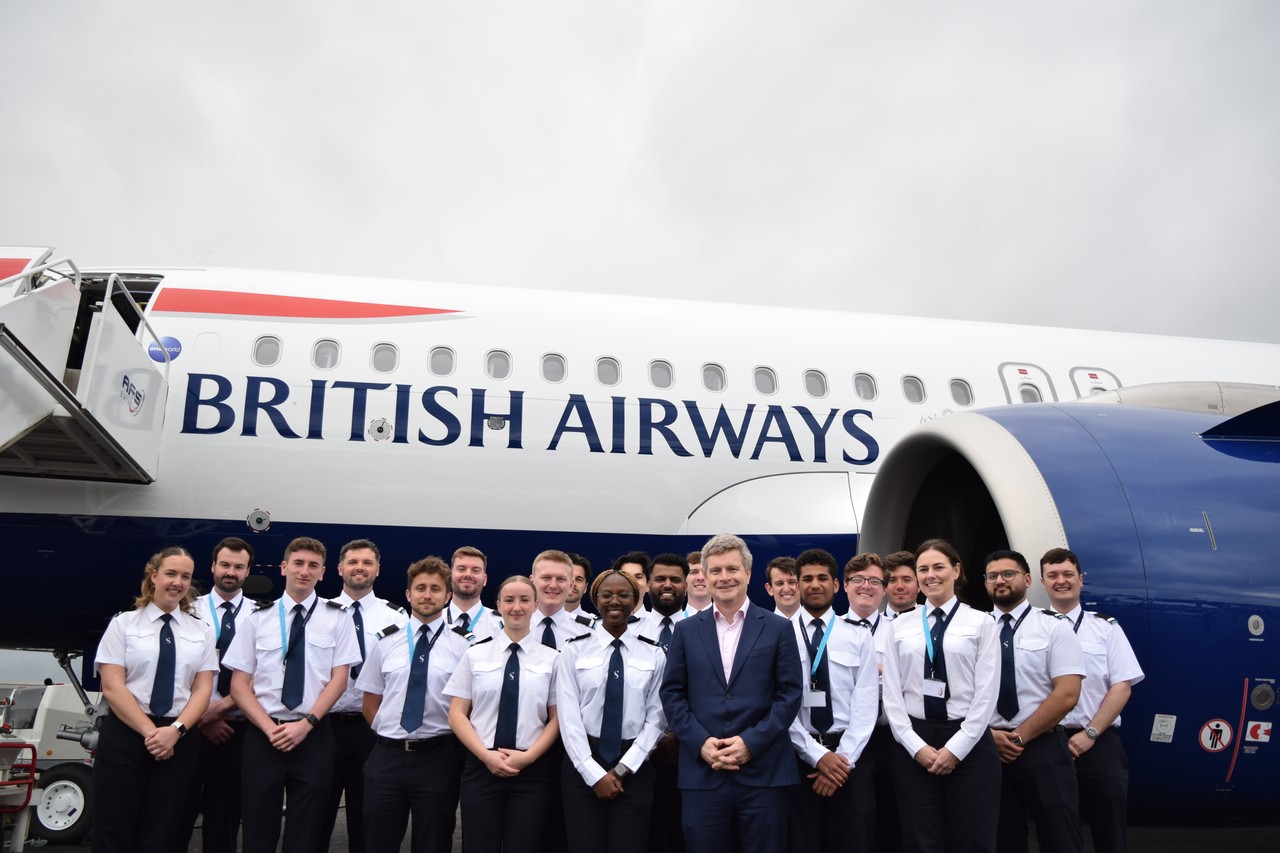
With BA’s Speedbird Academy, you don’t have to put any money up front at all. The selection process is extremely tough as it’s highly competitive, but once you’re on the course, you’re not required to pay for any training costs.
Similar to Wizz Air’s scheme, British Airways will recoup its training costs once the cadet has started operating as a pilot for them. They do this by putting them on a reduced salary for a number of years.
With the Speedbird Academy, you’ll have more certainty over a few things. You know that you’ll be based at London’s Heathrow airport, and it’s highly unlikely that this will change for the foreseeable future. Although you’ll be ‘fleet frozen’ on the A320 for six years, you’ll have the opportunity to join the long-haul fleet after this, which is something Wizz Air can’t offer.
TUI MPL Cadet Programme
The main differences with the TUI fully-funded schemes are that you’ll gain a different type of licence. The TUI scheme will provide you with an MPL rather than a frozen ATPL. I’ll create an article in the future explaining the differences, but for now, see Pilot George’s article on MPL vs ATPL here.
TUI have bases all around the UK and you could end up having to relocate to any one of them. You’ll also be type-rated on the Boeing 737. There will be an opportunity there to quickly progress onto the 787 and potentially be dual-rated.
Air Lingus Future Pilot Programme
Air Lingus’ programme will also gain you an MPL licence rather than an ATPL. Their FAQs, along with T&C’s, are much less revealing than the others, however, it’s clear that there is a bond period, during which time, if you leave the airline, you’ll be expected to pay the course costs back. You’ll also be on a reduced salary once you start flying, until the bond is paid off.
One certainty with the Air Lingus programme is that you’ll be based in Ireland and also type-rated onto the Airbus fleet. Overall, I’d say this scheme is more suited for Irish nationals or someone very open to relocating to Ireland for up to five years.
Jet 2 Future Pilot Cadet Programme
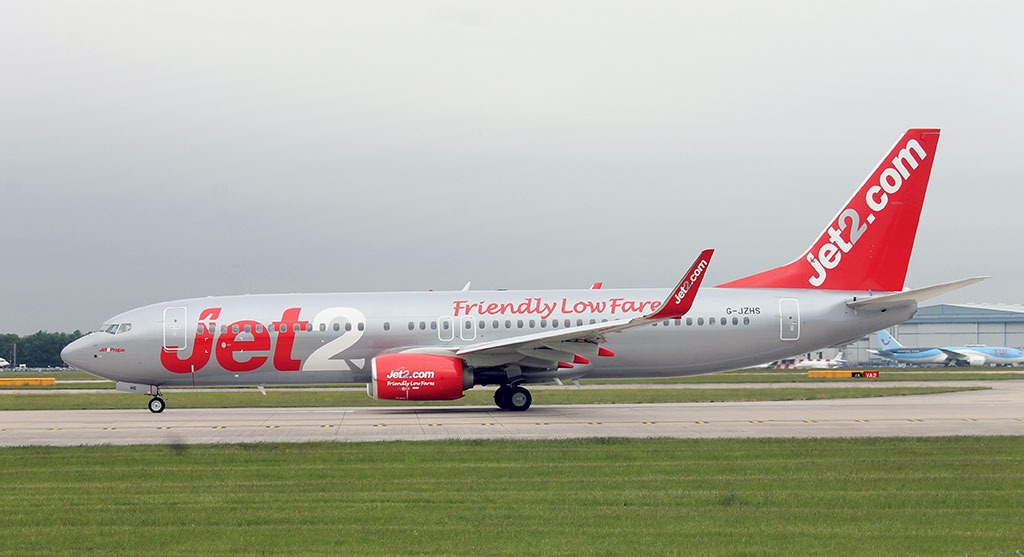
This is the new kid on the block when it comes to airline pilot training courses. Jet2 offer a fully integrated ATPL course, which also requires no money up front from the trainee. As with all the courses here, the trainee is bonded to Jet2 for several years afterwards.
The training programme and job opportunity offered by Jet2 are pretty great, and I’d highly recommend reading my in-depth article about that scheme here. You can also read another of our articles about what life at Jet2’s like, written by a current Jet2 first officer, found here.
Conclusion
Overall, the Wizz Air Pilot Training Academy is a good thing for the industry, and it’s a course which should appeal to many aspiring pilots. The airline is removing a significant barrier to entry for most: the cost of initial training. The way they defer most of the training costs until you’re on a salary with them, enables those who don’t have access to €100K, to still become airline pilots. You’ll, of course, be required to repay these costs, but if you stay with Wizz for five years, they’ll take €20K off what you owe them, which isn’t to be sniffed at!
The training course itself looks solid, and at the end of training, you should have an offer of employment with Wizz Air waiting for you. You’ll also have an ATPL (frozen) and an A320 type rating, which can open up other opportunities in the industry.
It sounds, however, like it’s tough to pass the selection process and land a place on the course, and only those with the right to live and work in the EU can do so. The entirety of the training course takes place in Hungary, and once you finish training, you may not have much say over where you’ll be based. Repayment of the training costs will commence when you officially commence employment, and they’ll be paid at a minimum of €1000/month, gradually increasing over the first five years of your career there.
These aren’t considerations to be taken lightly, nor is the commitment of time and resources, especially if you are very settled or have a family. If you have the cash available to you now to self-fund a course, and the freedom to say no to being based away from home is essential to you, then it still might make sense for you to stick to that route. All that being said, this course from Wizz Air does bring many benefits, especially for those who would look to stay there for the long term.
Specific Resources:
Wizz Air Pilot Academy Website
Wizz Air Pilot Academy Brochure
PPrune Forums For Wizz Air Academy
If you’re considering applying or know someone who might, two resources I’d highly recommend digesting before doing so are:
‘Airline Captain: A Day in the Life’ – This very recent book is written by a current short-haul airline captain and details the day-to-day life. Reading it will give you unparalleled insight into what the job really consists of and help you understand if this is the right career path for you.
‘How To Become An Airline Pilot’ – This up-to-date guide will help you through the application and selection process, giving you the best possible chance of success.
One Response
Very good article. I was in WAPA – flying as FO now. I can confirm – the information here is relevant and accurate. Good luck to applciants!